
Introduction to 10 kinds of sintering processes of alumina ceramics
After powder forming, a well-shaped greenbody is obtained. This green body is then heated to a certain temperature, duringwhich it undergoes volume shrinkage and ultimately transforms into a densesintered body. This process is called sintering. The driving force for thesintering of alumina ceramic green bodies is primarily the change in thesurface energy of the powder, specifically, the decrease in surface energy andreduction in surface area, leading to the densification of the ceramic. Duringthe densification process of ceramic sintering, mass transport can occurthrough solid-state diffusion, including surface diffusion, grain boundarydiffusion, and lattice diffusion. Industrially, pressureless sintering iscommonly used.
**1. Pressureless Sintering**
Pressureless sintering involves sinteringmaterials without applied pressure under atmospheric conditions, making it themost widely used sintering method. It includes pressureless sintering in airand pressureless sintering under specific gaseous atmospheres. This methodrequires relatively high sintering temperatures, demands high specificationsfor the furnace environment, and tends to be relatively energy-intensive.
Al₂O₃ has a high melting point, so thepreparation of Al₂O₃ ceramics often requires adding sintering aids to achievedensification through liquid-phase sintering. This method generally promotesthe sintering of Al₂O₃ ceramics. Liquid-phase sintering in Al₂O₃ ceramicsinvolves chemical reactions that form a liquid phase, promoting diffusion andviscous flow to facilitate particle rearrangement and mass transport, therebylowering the sintering temperature and accelerating effective sintering.
Since pressureless sintering lacks anexternal driving force, it is very difficult to completely eliminate internalpores and achieve theoretical density. Special sintering techniques involveapplying external driving forces during the sintering of alumina ceramics topromote densification. Common special sintering processes currently includehot-pressing sintering, hot isostatic pressing sintering, microwave heatingsintering, microwave plasma sintering, and spark plasma sintering.
**2. Hot-Pressing Sintering**
Hot-pressing sintering involves applyinguniaxial pressure to the sample at high temperatures to promote fulldensification of the ceramic. Compared to conventional sintering, sinteringunder 15 MPa pressure reduces the sintering temperature by 200°C whileincreasing density by 2%, and this trend improves with increasing pressure. Forpure alumina ceramics, conventional sintering requires temperatures above1800°C, whereas hot-pressing sintering at 20 MPa requires only 1500°C.
The pressure provided by hot-pressingsintering promotes atomic flow within the particles. Simultaneously, bothpressure and surface energy act as driving forces, enhancing diffusion. Sincehot-pressing sintering can achieve densification at lower temperatures, itinhibits grain growth, resulting in samples that are dense, uniform, have finegrains, and high strength. However, it is not suitable for producingexcessively tall, thick, or complex-shaped products, has small productionscale, and high cost.
**3. Hot Isostatic Pressing Sintering**
Hot isostatic pressing sintering involvesapplying pressure simultaneously from all directions to the ceramic green body,lowering the sintering temperature while producing ceramics with uniformstructure and good properties. Although hot isostatic pressing can successfullylower the sintering temperature and obtain complex-shaped objects, it requiresprior encapsulation or pre-sintering of the green body, and the pressureconditions can be relatively stringent.
**4. Ultra-High Pressure Sintering**
Ultra-high pressure sintering is conductedunder relatively high pressure conditions. Due to the high pressure, atomicdiffusion is suppressed, and the nucleation barrier is relatively small,enabling the production of high-density (>98%), high-purity alumina ceramicsat lower temperatures. During ultra-high pressure sintering, the presence ofpressure increases the diffusion rates of vacancies and atoms within theparticles. Pressure, together with surface energy, acts as the sinteringdriving force, enhancing diffusion. Ultra-high pressure sintering typically requiresrelatively low temperatures, inhibiting abnormal grain growth, thus resultingin high-purity alumina ceramics with high densification, fine grain size, anduniform distribution.
**5. Microwave Heating Sintering**
Microwave heating sintering utilizes theinteraction between microwaves and the ceramic, causing simultaneous sinteringfrom the interior and surface of the ceramic due to dielectric effects. Unlikeother sintering methods, the heat flow in microwave sintering is from theinside out, facilitating the outward diffusion of gases from the green body.Meanwhile, microwaves enhance grain activity, making migration easier and thuspromoting densification.
Compared to other sintering methods,microwave sintering allows rapid heating and sintering, features a uniformtemperature field, low thermal stress, and is pollution-free. The sinteringtemperature in microwave sintering is 100°C to 150°C lower than conventionalsintering, and the sintering time is nearly an order of magnitude shorter.Under the same conditions, the density achieved by microwave sintering issignificantly higher than conventional sintering. Microwave sintering cansinter complex-shaped objects, and the resulting ceramics have small, uniforminternal grains and good fracture toughness.
**6. Microwave Plasma Sintering**
Compared to conventional sintering,microwave plasma sintering can reduce the sintering temperature by 200°C underthe same conditions, and it features fast sintering speed, small grain size,and high mechanical strength. One reason microwave plasma sintering promotesdensification is rapid heating, which reduces grain growth caused by surfacediffusion and provides a stronger driving force and shorter path for volumediffusion and grain boundary diffusion, thereby lowering the sinteringtemperature of alumina ceramics and refining the grains.
**7. Spark Plasma Sintering**
Spark plasma sintering is a relatively newsintering method developed in recent years. It utilizes instantaneoushigh-temperature fields generated by pulse energy and pulse pressure to achievespontaneous heating of internal grains within the ceramic, thereby activatingthe grains. Due to its fast heating and cooling rates and short holding time,this method inhibits grain growth, shortens the ceramic preparation cycle, andsaves energy. Spark plasma sintering is essentially a new type of hot-pressingsintering method. The resulting ceramic samples have uniform grains, highdensity, and good mechanical properties, making it a valuable and promisingsintering method.
In the preparation of high-purity aluminaceramics via spark plasma sintering, the heating rate significantly affects thedensification at different stages. In the initial sintering stage, a fasterheating rate increases the density of the sintered body, whereas in the latersintering stage, a faster heating rate leads to a decrease in the density ofthe sintered body.
**8. Two-Step Sintering**
The two-step sintering method involvesheating the sample to a specific temperature (T1) to eliminate subcriticalpores in the green body, then cooling to a lower temperature (T2) to achievedensification. During the low-temperature sintering stage of the two-stepmethod, since grain boundary migration requires higher activation energy thangrain boundary diffusion, grain boundary diffusion predominates in this stage.Therefore, in the second stage of the two-step method, the green bodycontinuously densifies, but grain growth does not proceed rapidly. Aprerequisite for full densification in the low-temperature stage is that thepores gradually become closed pores during the shrinkage process of the greenbody.
**9. Microwave Two-Step Sintering**
The two-step sintering method can beperformed in traditional sintering furnaces, offering low equipment costs andstrong application value. However, because it requires prolonged holding at thesecond temperature point, it is a relatively slow sintering process. Microwaveheating is typically known for its advantages of volumetric and rapid heating,and few studies have combined microwave heating with the two-step method.However, the characteristics of microwave heating—lowering sinteringtemperature and shortening sintering time—would favor further grain refinementand effectively shorten the production cycle of the two-step method.
**10. High Vacuum Sintering**
High vacuum sintering is a sinteringtechnique conducted under a high vacuum state. Vacuum sintering has attractedattention from many researchers in preparing ceramics with low porosity andfine grains due to its advantages, such as potentially reducing heating rates,inhibiting abnormal grain growth, and decreasing irregular porosity.
High vacuum sintering can not only enhancesome properties of high-purity alumina ceramics but also reduce impurities atgrain boundaries and pores within the sintered body. During the preparation ofhigh-purity alumina ceramics by vacuum sintering, oxygen ions in the aluminalattice are easily lost, forming a large number of oxygen vacancies. The relativeincrease in aluminum ion concentration accelerates the diffusion process ofaluminum ions, facilitating the sintering process.
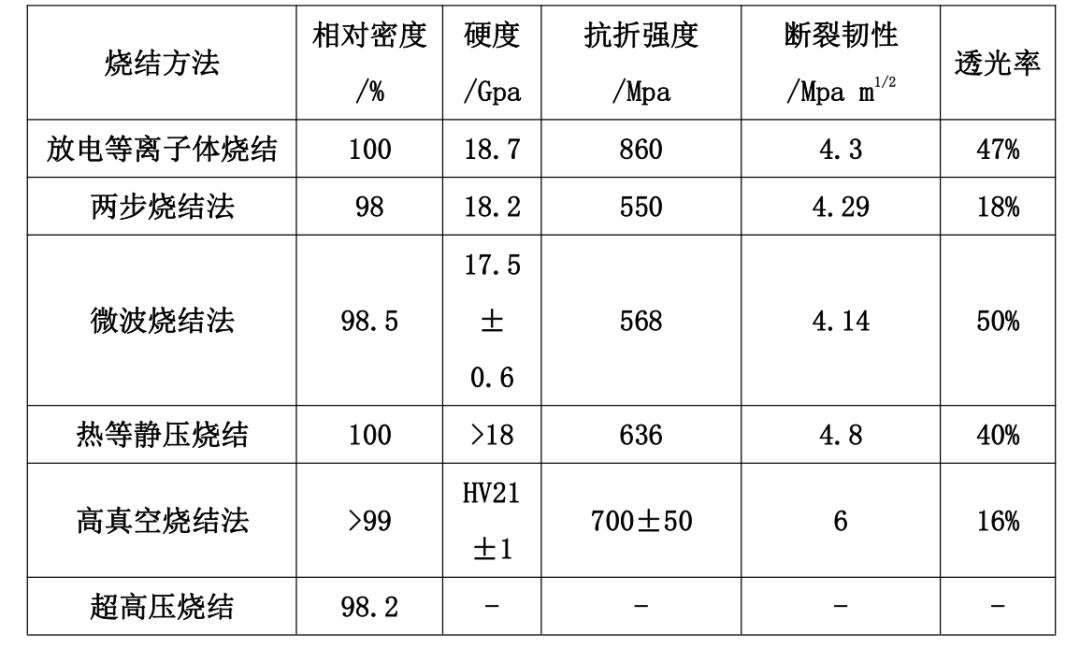
**Appendix: Performance Comparison of Alumina Ceramics Prepared by Different Sintering Methods**
Source: Dai Jinshan. Study on Pressureless and Hot-Pressing Sintering and Properties of High Purity Alumina Ceramics
Statement: The content is republished from the Advanced Ceramics Alliance. Sharing only, does not represent the position of this account. If infringement occurs, please contact us for removal. Thank you!

Email:djy@zhongmingci.com

Email:hanyy@zhongmingci.com

Landline:+86-0572-6960175
+86-0512-65794818/67566118
Email:raymond@zhongmingci.com


